Showing posts with label games. Show all posts

Wednesday, February 2, 2022

HEALTH AND WELL-BEING

Olympic day 2022 in preschool

Keeping our fingers crossed and supporting our Latvian olympicians at Beijing Olympics, on February 1 our preschool children gathered at our kindergarten's sports field to strengthen their health, physical endurance and to participate in our own Olympic games.


Like in real olympic games, group delegations entered the stadium holding a plate with group name. 

From each groups a representative was elected to carry the Olympic flag around the stadium up to the flagpole while marching music was played. Then the Olympic anthem was played and the flag was raised.


Now it was the time to bring in the Olympic torch. Again child of each group brought it around our sports field.  To greet the olympicians and to wish them success in the Olympics, the coordinator of Olympic games from China herself came to visit our event (the translation was provided by our speech therapist)  :)))


The main judges of each discipline invited children to try their skills in: 
Wolf - bobsleigh. Children had to slide from the hill with a ball in their hand and try to hit it in the target.

dog Piff  invited to sledging activity. One kid pulled the sledge, the other pushed it, while the third was sitting in holding a rubber ring. They had to go along cones and at the end of the road put the rubber ring on a stick and "drive" back.

Bear provided biathlon. Children were divided into teams of 6. Each child took two balls. After start signal they ran around the stadium, run into "shooting range" and only when all the children of their team had run in, they could throw balls, trying to hit the pins.

Piglet told children to find the way out of snow maze. At the end of the maze they had to crawl under the ribbons and run to the start along the snow path. They had to make three laps each.


the coordinator from China invited to try hockey and longslide. 


Everything was documented by Eurosport photographer Zebra.


After active participation all participants and judges received olympic stickers. 

Let's be healthy!


Friday, January 28, 2022

 ANIMALS IN OUR NATURE

To teach children about animals we have used different games. Like this Big Nature game where children can be active and work themselves - observe, find out, search, compare, name, find relevant, make up the lines of folk-songs, guess riddles or invent their own, and many more.


Animals also come to help children to discover and learn different skills and knowledge:

*about letters


*about counting


*about colours, shapes and first counting skills.


While playing and helping the animals children acquire various skills and indirectly discover about their chracteristic look and behaviour.

 ANIMALS IN OUR NATURE

There are lots of movement activities in Latvian about animals which we use in our sport lessons to reveal to children the characteristic behaviour of animals ad their relations with other animals. Here we offer only a tiny amount which we have used in our sport activities.

For 1.5-3 years old.

"Hare's house"

Whilse there is a song playing about a hare (teacher can also sing it), children-hares are playing and jumping in the wood (sport hall). When the music stops (or  the drums beat) children-hares must find one house (hoola hoop or air pillow) to hide themselves from wolf or just to stay for the night.


For 3-4 years old.

"Diligent squirrels"

Children (squirrels) are divided into 4 teams. Each team is standing near their hollow (hoola hop) in which there are placed equal number of nuts, chestnuts or acorns in each. After a signal squirrels go to other hollows and, taking only one nut (acorn, chestnut) at a time, bring them to their own hollow. The teacher is counting to 10 and says STOP. After that no nut can be taken. Now squirrels count how many nuts there are in their hollow. The team which has the biggest number of nuts has won.


For 4-5-6 year old

"Cat and mice"

One cat is selected the other children are mice. Mice put one end of a twine in their sport trousers to make mice tale. The cat tells two lines of the rhyme and starts catching the mice. Cat must pull out the twine - then the mice is caught. The caught mice go to rest.


For 4-5-6 year old

"Hare and fox"

Children stand in hoola-hoops in pairs. There is also one fox and one children is hare - holding one in hands. The fox chases the hare. It runs away, it runs up to one pair gives a hair to one child and then this child must run away from the fox. Then this child who has the toy hare now, tries to give it away to another child, then this child runs away from the fox.

"Birds in nests"

Children stand in pairs in hoola-hoops that are placed in circle. One child is a tree (arms are put in the waist), the other child is the bird - he puts his arms on the "tree's shoulders". There is one bird without a tree (without nest).  The teacher says "All birds are flying" and all birds fly in the middle of the circle. The teacher says "All birds in nests" - each bird tries to find his tree and place hands on the shoulders of the "tree". One bird stays without nest.
After a while trees and birds chnge their roles.


Saturday, January 15, 2022

 ANIMALS IN OUR NATURE

To practice memorising the names of different animals that live in our country and elsewhere in the world, every group took as a help various games. 

Little ones tried to name animals that can be found in our country and find a similar one.

Little older children tried already to tell the first letter with which starts the name of each animal.

Older ones tossed cardboard strips and got a little riddle - they had to find to which animal the given animal one is going. By following and naming the directions (to the left, to the right, up, down), they saw which animal the given one has visited. Then they had to find this animal in the pile of squares and place it on the strip of cardboard


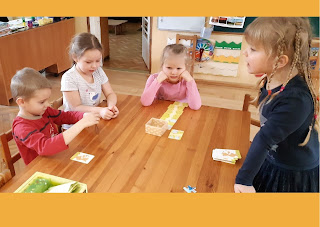
Children also practiced to put the names of the animals from letters (either block letters, small letters, written letters) or write the word by themselves. According to their capabilities. They could use "helping sheets" if needed. 


Wednesday, November 3, 2021

Animals in our nature - Remember the name

The names of the animals were unknown to the children and difficult to remember, so we offered them activities that help them learn in a fun way.


Putting together words from letters on stone. The child chooses a picture of the animal below, decides what the name of that animal is and then has to put the letters together in the correct order.


The next activity was to connect the image and the name. It is designed to be played on a magnetic board, but children also played a memory game with it.


Tuesday, September 21, 2021

Our forest - Estonian forest

 THEME: ESTONIAN FOREST (project)

CHILDREN AGE: 4-6 years

OBJECTIVES: The child knows the worth of the forest in our nature. The child knows trees in Estonia. The knows the names of the trees and tells them (pine, fir, birch). The child knows what the tree needs to grow (soil, water, light). The child watches different pictures and books from trees. The child is active in discussions. The child draws favorite tree. The child cuts out and glues it on the given base paper. The child finds things made of wood in the group. The child knows that pen is made of wood. The child actively participates in doing group art work (tree from leftovers from sharpening pens). The child knows how to use digital storytelling pen. The child knows how to play digital game about forest and nature.

TOOLS/MATERIALS: different books and pictures about forest; wax chalks, paper, base paper, scissors, glue; pen, PVA-glue, leftovers from sharpening pens, crepe paper, base card; digital storytelling pen and its sets about nature.

ACTIVITY:

- Pictures - looking, discussions

3/4 from Estonia is covered with forest and bog. Forest is a part of our culture, our way of thinking. Estonia is rich of its untouched nature. 

With children - our forest values - made a concept map.

Then we discussed what is forest protected areas. We reminded concept nature protection. We found out that there is 3000 trees per person in forests. The average tree age is about 60 years. We discussed that who has planted trees in the forest. Talked about different forests is Estonia. The most we have pine trees, then comes birch, fir and so on. Then we looked the books about forests. 

We found out that from one average tree you can have 70 kg paper or 10 000 sheets of paper A4. Discussion, is it a lot or not?

Then we discover the trees on our kindergarten yard. Like the rowans are planted by children who graduated our kindergarten 13-15 years ago. And the birch trees are older then 60 years. We compare them and we name adjectives about them.


- Drawing

The children draw the tree that they like the best, cuts it out and glues on the base paper to make collaborative art work. Together it is a forest.

- Discussion

What is made of wood? Find things from the group room what is made of wood. 

Pens - are made of soft wood, without branch knot and is easily cut that's why it is easy to sharpen them. And all of the pen ends up in trash. We don't use it. Or can we use it? What can we do that less of pen ends up in trash? To use pen wisely, cut less and not so often. But how can we use the leftovers?


- Art work

In collaboration we made a tree from the pen sharpening leftovers. We drew a tree, put some PVA-glue on it, then on the glue went pen sharpening leftovers and we decorated it crepe paper leaves. 


- Embedding the topic - on free time

Children can use the digital storytelling pen, read and look books about nature, play board games of nature and so on.